
Hamilton County Court Records After Arrest
The jail roster is a custody record. The court record is the formal case record. In Hamilton County, a person arrested and booked by HCSO under Sheriff Charmaine McGuffey may first appear in the Hamilton County Justice Center inmate search, then appear in the Hamilton County Clerk of Courts records-search system as the case opens. The court record can show the case number, filed charges, court dates, docket entries, bond orders, warrants, and final disposition. It is the better source when the question is what charge was actually filed, amended, dismissed, bound over, indicted, or resolved.
Booking detail and court detail should be read together. The Hamilton County jail inmate records page covers current custody, booking number, and jail-contact channels. The court record after a jail arrest shows the legal case that follows. For booking photos, use the separate Hamilton County jail mugshots page because court files do not function as a booking-photo gallery. A charge on the roster can differ from the charge the prosecutor later files, and a person can be charged without being convicted.
The Hamilton County Clerk records-search menu is the main public starting point for online court records after a jail arrest.
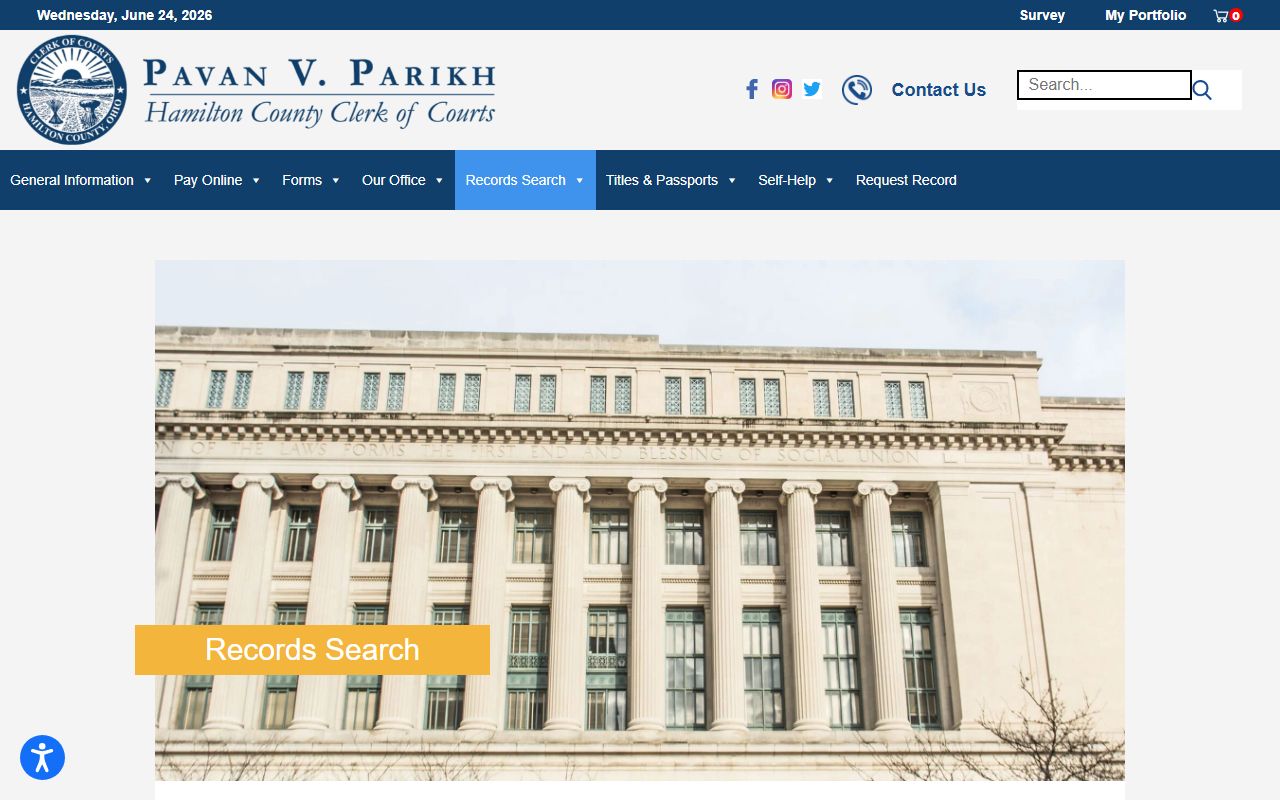
The menu separates name, case number, schedules, tickets, attorney, judge, and other searches, which helps users move from a jail booking to the correct court record.
Find Hamilton County Court Records After Arrest
Hamilton County's government court-records page routes users to the Clerk of Courts website, where cases can be searched by name, number, other party name, or ticket. The Clerk's criminal and traffic name search page says web searches are by name only and gives search hints. For best results, use the last name and the first few letters of the first name. If the jail roster already shows a case number, the Clerk's case-number search is more precise.
- Open the Hamilton County Clerk records-search page.
- Use name search when only the defendant's name is known, or use case-number search when the roster or court notice lists a case number.
- Select the relevant court category, such as Municipal Criminal/Traffic or Common Pleas Criminal, when the search interface offers toggles.
- Open the case and review the charge list, docket entries, next court date, bond entries, and disposition fields.
- Compare the court docket with the HCSO roster if custody, jail bond, or holder information is still unclear.
Background checks are separate. The Clerk's criminal and traffic search page says background checks are available only in person at Justice Center Room 100, Monday-Friday, 7 AM-3 PM. That is not the same as a public web docket lookup. Statewide BCI or FBI background checks are also separate from a Hamilton County Clerk name search. No Hamilton County Sheriff's Office Ohio app with court, warrant, or roster lookup was found; use the Clerk, HCSO, VINE, ODRC, BOP, and ICE channels instead.
Hamilton County Court Search Fields
The Clerk provides more than one search route. Name search helps when a person has just been arrested and no case number is known. Case-number search helps once a roster charge, summons, docket notice, or attorney paperwork identifies the court case. Date-of-birth or date fields may narrow criminal records, and court-category toggles help separate Common Pleas, Municipal, Domestic Relations, Court of Appeals, civil, and traffic records.
| Field Label | Type | Required | Options or Notes |
|---|---|---|---|
| Last Name | Text | Yes for name search | Clerk suggests last name plus first few letters of first name. |
| First Name | Text | Narrowing | Partial first name may improve results. |
| Date of Birth or Date | Date/text | Optional | Formats include mm/dd/yyyy, mm/yyyy, or yyyy on relevant search screens. |
| Court/category toggles | Checkbox or toggle | Optional | Common Pleas Criminal, Municipal Criminal/Traffic, Domestic Relations, Court of Appeals, and civil options. |
| Case Number | Text | Yes for case search | Use the exact Clerk case number when known. |
The source screenshot for the Clerk criminal and traffic name search shows the online search context and background-check notice that applies to Hamilton County court records after arrest.
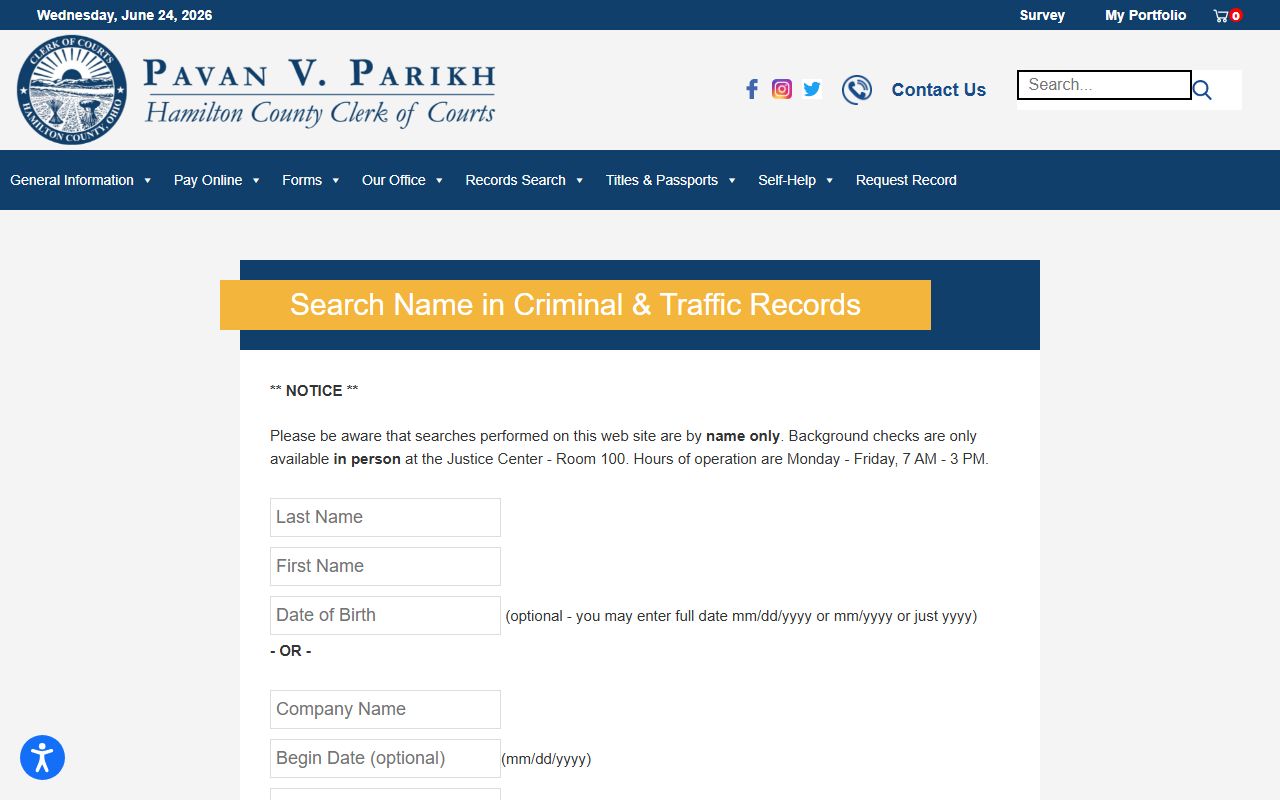
That notice is important because a name search is not a certified background check, even though both may involve criminal court records.
Hamilton County Charging Documents
After arrest and booking, the legal case develops through charging documents and court action. A complaint may start early proceedings, especially in municipal or initial felony settings. Hamilton County felony cases route through the Hamilton County Prosecutor's Office, where the Grand Jury/Intake page identifies Intake as the entry point for all felony cases. An indictment is returned by a grand jury, and an information is a prosecutor-filed charging document used in some cases when allowed. The Clerk case record is where those filings and later docket events are tracked.
| Document | Who Files or Returns It | Typical Role After Arrest |
|---|---|---|
| Complaint | Officer or prosecutor | Starts an early criminal case and may support initial court action. |
| Information | Prosecutor | Formal prosecutor filing used in some felony paths when legally permitted. |
| Indictment | Grand jury | Formal felony charge returned after grand jury review. |
Ohio counties use a Prosecuting Attorney, not a District Attorney. The current Hamilton County Prosecuting Attorney is Connie Pillich. Her office handles felony criminal offenses occurring within Hamilton County through the Criminal Division, while misdemeanor and traffic cases may follow municipal or city prosecution structures depending on the charge and court.
Hamilton County Charge Status
Charges can change after an arrest. A roster entry may show a booking charge, hold, or initial bond entry, while the Clerk docket later shows the charge filed by the prosecutor, the grand jury, or the court. That is why a Hamilton County court record after arrest should be checked for current status before drawing conclusions. A case can be pending, amended, reduced, dismissed, bound over, indicted, or resolved by plea, verdict, diversion, or acquittal.
| Status | What It Means |
|---|---|
| Pending | The charge or case is active and has no final disposition. |
| Amended | The charge was changed by prosecutor or court action. |
| Reduced | The charge was lowered to a lesser offense. |
| Dismissed | The charge ended without a conviction on that charge. |
| Nolle prosequi | The prosecutor declined to continue that charge. |
| Bound over | An initial court sent a felony matter toward grand jury or Common Pleas handling. |
| Indicted | A grand jury returned formal felony charges. |
Bond After Hamilton County Arrest
Bond and release information may appear both in the HCSO inmate detail and the court docket. The roster can show bond type and bond amount by charge, including local codes such as C/S, C/PR, H, NONE, or N/A in indexed official snippets. The court record is the better place to confirm the formal bond order because bond can be set, changed, continued, or denied at first appearance, arraignment, preliminary hearing, indictment, bond review, or later proceedings.
| Bond Type | How It Works |
|---|---|
| Cash/Surety | Money or surety bond is generally required, subject to the court order. |
| Cash/PR | May combine a cash amount with personal-recognizance release terms. |
| PR or recognizance | Release based on a promise to appear and follow conditions. |
| Holder | Another agency, court, county, APA, federal authority, or jurisdiction may block release. |
| No bond | No release bond is available unless the court changes the order. |
HCSO pages inspected did not publish a complete bond-posting counter, hours, or accepted payment path. The practical chain is to check the jail detail, check the Clerk case, and call Jail Records or Jail Services before paying or contacting a bond agent. A separate warrant, APA holder, ICE detainer, federal hold, or no-bond order can keep someone in custody even when another charge lists an amount.
Hamilton County Warrants After Arrest
Hamilton County, Ohio did not have a broad public HCSO open-warrants search in the inspected material. The sheriff site does publish warrant-unit contact information and some specialized lists, such as child-support violations. HCSO lists Felony Warrants at 513-946-5350. The Fugitive Warrants Unit is tied to service of grand jury indictments, capiases, and Common Pleas warrants, with published numbers 513-946-5350 and 513-946-5366 during normal business hours, plus 513-946-5353 after hours in the child-support context.
A warrant can lead to a jail arrest and then a Hamilton County court record. A bench warrant, capias, indictment warrant, or fugitive warrant may appear in the Clerk docket even where no general sheriff warrant list exists. People checking their own possible warrant exposure should use counsel when appropriate because direct law-enforcement contact about an active warrant can result in arrest.
Hamilton County Charges vs Convictions
An arrest and charge are not the same as a conviction. A charge is an accusation or filed offense that begins or continues the court case. A conviction requires a guilty plea, no-contest plea with finding, jury verdict, bench verdict, or other court disposition that creates a conviction. Hamilton County court records after a jail arrest should be read with that distinction in mind, especially when a roster shows early booking charges that later change.
| Point of Comparison | Charge | Conviction |
|---|---|---|
| Stage | Accusation or filed offense | Final finding or plea outcome |
| Standard | Early legal basis such as probable cause or formal filing | Proof beyond a reasonable doubt or accepted plea |
| Can change? | Yes, it may be amended, reduced, dismissed, or indicted differently | Can be appealed or later affected by sealing or expungement rules |
| Public record? | Often public unless restricted | Often public unless restricted, sealed, or expunged |
Hamilton County Sealed Records
Ohio record sealing and expungement paths are governed through ORC Chapter 2953 and related court orders. Sealing generally hides a record from ordinary public view while allowing certain authorized access. Expungement is more limited and can involve destruction or treatment as if the record does not exist under the applicable law and order. Eligibility depends on the case outcome, offense type, waiting period, prior record, and court ruling. The Clerk docket or court order controls the public status.
| Point of Comparison | Sealed | Expunged |
|---|---|---|
| Public visibility | Hidden from most public searches by court order. | Removed or treated as destroyed where the law allows. |
| Government access | Some agencies may retain limited access. | Access is narrower and depends on the order and statute. |
| Eligibility | Depends on Ohio law, offense, disposition, and timing. | Depends on Ohio law and the specific court relief granted. |
A dismissed charge does not always vanish from public view without a sealing or expungement order. Once a record is sealed, public sites and informal copies may lag behind the court record. Verify the current public status with the Clerk and the court order rather than relying on old screenshots, search caches, or copied databases.
Restricted Hamilton County Court Records
Ohio public records law, including ORC 149.43, supports public inspection and copying of many records kept by public offices, but it also allows exemptions. Juvenile records, sealed records, expunged records, medical data, victim information, confidential law-enforcement investigatory material, and some ongoing-investigation material may be withheld, redacted, or routed through a separate process. The public docket is not a complete law-enforcement file.
Important: Do not use informal court, roster, or arrest lookups for employment, credit, housing, insurance, or other FCRA-covered decisions.